
The finance industry is undergoing a fundamental transformation, and artificial intelligence (AI) is at its core. From banks and insurance firms to fintech startups, the entire industry is undergoing a digital evolution powered by intelligent algorithms and machine learning models.
A 2024 Gartner survey revealed that 58% of finance companies are already using AI, a sharp rise from just 37% the year before. And the money is following the momentum. The financial sector is projected to spend nearly $97 billion on AI by 2027, up 29% from 2023 levels, according to Forbes.
So what does this mean in practice? Simply put, AI is making finance smarter by cutting costs, reducing risk, and making decisions faster. Let’s explore how.
What is Artificial Intelligence (AI) in Finance?
Artificial intelligence (AI) in finance refers to the use of advanced algorithms, machine learning models, and data-driven automation to analyze information, make predictions, and perform complex tasks that traditionally required human intelligence. In this context, AI systems process vast amounts of financial data to detect patterns, assess risks, optimize operations, and improve decision-making across banking, investing, insurance, and personal finance.
Unlike rule-based systems, AI can learn from experience, adapt to new data, and continuously improve its accuracy. This makes it particularly well-suited to an industry as dynamic and data-heavy as finance. From detecting fraud in real-time to predicting market movements and personalizing financial advice, AI is enabling faster, smarter, and more secure financial services.
What Are the Benefits of AI in Finance?
AI is changing how financial institutions work. It helps them move faster, reduce errors, and serve customers better. Here’s a look at the key benefits.
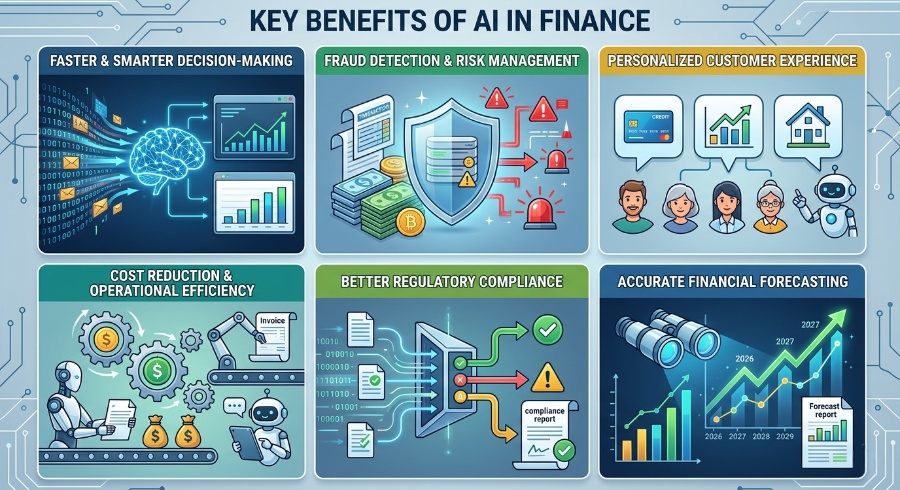
Faster and Smarter Decision-Making
AI processes large volumes of data in seconds. It identifies patterns that humans might miss. This helps banks and financial firms make quicker, more accurate decisions.
Fraud Detection and Risk Management
AI monitors transactions in real time. It flags unusual activity before damage is done. This reduces fraud losses and strengthens security across digital banking platforms.
Personalized Customer Experience
AI analyzes customer behavior and financial history. It then recommends products and services that match individual needs. This makes interactions more relevant and improves customer satisfaction.
Cost Reduction and Operational Efficiency
Manual processes slow teams down and drive up costs. AI automates repetitive tasks like:
-
Data entry and reconciliation
-
Invoice processing
-
Compliance reporting
-
Customer query handling via chatbots
This frees up teams to focus on higher-value work.
Better Regulatory Compliance
Keeping up with financial regulations is complex. AI tools continuously monitor transactions and flag compliance risks. This reduces the burden on compliance teams and minimizes the risk of penalties.
Accurate Financial Forecasting
AI uses historical data and market trends to predict future outcomes. This helps businesses plan budgets, manage cash flow, and prepare for market shifts with greater confidence.
How is AI currently being used in Finance?
AI is transforming virtually every corner of the financial services industry. Here’s how:
- Fraud Detection: AI detects unusual patterns in transactions and flags suspicious activity instantly, helping prevent fraud before it causes harm.
- Credit Scoring & Risk Management: Financial institutions use AI to assess loan applicants more accurately by analyzing a wider range of data beyond traditional credit scores.
- Customer Support: AI-powered chatbots and virtual assistants provide 24/7 support, handle routine queries, and guide users through complex processes like loan applications or account setup.
- Algorithmic & High-Frequency Trading: AI models react to market conditions in real time, executing trades in milliseconds to capture short-lived opportunities.
- Personal Finance Management: AI powers budgeting apps and robo-advisors that help individuals track spending, plan savings, and invest wisely—often at a lower cost.
- Compliance & Regulatory Monitoring: AI streamlines Anti-Money Laundering (AML) and Know Your Customer (KYC) checks by automatically analyzing large volumes of data to flag potential risks.
- Insurance & Claims Processing: From automating claim approvals to estimating damage using images, AI speeds up and simplifies insurance workflows.
Want to build intelligent, secure financial tools customized to your needs? Check out our Financial Software Development Services to see how we help companies across banking, insurance, and fintech innovate with AI.
What are the applications of AI in the financial sector?
Artificial intelligence is making waves across every facet of financial services, driving innovation from frontline customer interactions to deep analytical insights.
AI in Fraud Detection & Information Retrieval
AI isn’t just detecting fraud; it’s redefining how banks think about risk, speed, and cost-efficiency.
- Real‑Time Anomaly Detection
Traditional systems often rely on fixed rules and historical thresholds, which fraudsters can eventually learn to bypass. AI, on the other hand, detects abnormal patterns in real time by analyzing transaction metadata like location, time, device, user behavior, and thereby flagging deviations instantly. - Efficiency with Every Detection
AI doesn’t just detect fraud better; it also makes it cheaper. A McKinsey study reports that banks using AI-driven tools have cut fraud detection costs by around 30%, largely due to faster, automated resolution and fewer false positives. - Evolving with the Threat
AI fraud detection platform continuously learns from every attack attempt. Instead of relying on static rules, it adapts in real time, staying a step ahead of ever-evolving scam tactics. - Instant Document Querying with AI
AI also improves access to internal financial knowledge. For example, Mindfire Solutions has developed a chatbot that sifts through large PDF reports and answers user queries instantly. This reduces manual search time by up to 90%, letting employees and customers alike get what they need faster than ever before.
AI in Banking
AI is now deeply embedded across the banking value chain, covering everything from credit decisions to compliance.
- Smarter Credit & Risk Models
Modern banks use AI to assess default risk using multi-source data, including income flows, spending behavior, employment trends, and macroeconomic indicators. AI in banking also plays a critical role in liquidity management, helping institutions predict cash flow gaps before they become problems. - Cash Flow & Liquidity Forecasting
AI models forecast account activity and liquidity needs by studying historical transaction data and external stressors. Banks use this to spot potential cash crunches early and maintain buffer reserves even during volatile times. - Chatbots for Always-On Customer Support
AI-driven assistants from platforms like Mindfire or IBM Watson now resolve everyday tasks: checking balances, initiating transfers, and setting reminders. They respond in real time, speak multiple languages, and never sleep, unlike human agents. Explore a detailed case study on AI-Powered Finance chatbot here - Compliance and Anti-Money Laundering (AML)
AML compliance typically drowns teams in alerts, while most of them are false. AI filters out the noise, focusing analyst time on truly high-risk transactions. The result? Faster reviews, lower operational load, and stronger compliance outcomes.
AI in Investment & Wealth Management
AI isn’t just helping traders react faster. It’s helping investors of all types make smarter, data-driven decisions.
- High-Frequency & Algorithmic Trading
AI systems ingest news, earnings reports, and price data around the clock. They execute trades at lightning speed, taking advantage of market inefficiencies before human traders can even react. - Robo-Advisors for Personalized Investing
AI-powered robo-advisors analyze user preferences, income, and risk tolerance to offer custom portfolio advice. Platforms like Betterment and Wealthfront are already serving millions using this model. They also auto-rebalance portfolios as markets shift, reducing exposure to risk without needing user intervention. - Alternative Data for Smarter Bets
Modern AI systems look beyond Bloomberg terminals. They use satellite imagery (e.g., car volume in retail parking lots), social media sentiment, and even supply chain data to predict earnings surprises or downturns. These signals give investors an edge, especially in short-term positioning. - Stress Testing & Backtesting
Investment firms simulate market crashes, interest rate hikes, or geopolitical shocks to test strategy resilience. AI crunches years of data to forecast how portfolios might behave under stress, helping firms better manage exposure.
AI in Retail & Personal Finance
AI is no longer a luxury for financial institutions; it’s reshaping everyday money decisions for individuals.
- Budgeting & Expense Tracking
Apps like Mint and YNAB use AI to automatically categorize expenses, detect spending patterns, and send real-time alerts. Users get nudges when they’re nearing limits, suggestions to save, or reminders of upcoming bills—all personalized. - Robo-Advisors for Personal Portfolios
Consumers are now managing entire investment portfolios via AI at a fraction of the traditional cost. These robo-advisors run simulations, diversify risk, and adjust allocations—making wealth management more accessible. - AI in Insurance Claims
AI-driven computer vision is transforming how insurance claims are processed. For instance, a user can upload photos of a damaged vehicle, and the AI instantly estimates repair costs—cutting claim turnaround from weeks to hours. - AI Chatbots for Lending & Internal Support
Mindfire’s AI finance assistant helps users navigate lending applications with step-by-step support. On the employee side, their Retrieval-Augmented Generation (RAG) chatbot gives staff instant access to internal FAQs, HR policies, and compliance docs—no more digging through PDFs or emailing support.
To explore more on how AI is shaping consumer behavior and retail strategies, check out our blog on AI in Retail.
Emerging AI Technologies Shaping Finance’s Future
As financial institutions continue to innovate, several cutting-edge AI technologies are poised to redefine how finance operates in the coming years. These advancements promise greater efficiency, transparency, and real-time decision-making capabilities.
Generative AI in Financial Services
Generative AI is transforming financial operations by producing human-like outputs based on data patterns:
- Automated Report Generation: Financial institutions are increasingly using generative AI tools to convert complex raw data into clear summaries, investment analyses, and regulatory reports, dramatically reducing manual effort and accelerating workflows.
- Synthetic Data Creation for Testing: AI can generate realistic but artificial transaction data to train fraud detection and risk models safely, protecting customer privacy while enhancing model accuracy.
- Personalized Financial Content: Robo-advisors and AI platforms deliver customized investment advice, market insights, and retirement planning tailored to individual client profiles, improving engagement and user experience.
Explainable AI (XAI) for Transparent Decision-Making
With rising regulatory scrutiny and demand for transparency, explainable AI helps reveal how AI models make decisions:
- Regulatory Compliance: Financial organizations leverage XAI tools to clarify the reasoning behind decisions like credit approvals or denials, supporting regulatory requirements and internal audits.
- Building Customer Trust: By providing users with understandable explanations for recommendations or alerts, AI-powered systems foster greater confidence and satisfaction.
- Reducing Bias: Interpretable machine learning models assist in identifying and mitigating biases within credit scoring or risk assessments, promoting fairer outcomes.
Edge AI for Real-Time Processing
Deploying AI models directly on devices or local servers enables financial services to process data with minimal delay:
- Fraud Detection at the Source: Edge AI allows instant analysis of transaction patterns at payment terminals or point-of-sale devices to prevent fraudulent activity immediately.
- Instant Loan Approvals: Mobile applications use on-device AI to quickly evaluate creditworthiness, offering faster loan decisions without relying heavily on cloud processing.
- Reduced Trading Latency: Financial firms use edge computing close to exchanges to execute trades with ultra-low latency, gaining a speed advantage in fast-paced markets.
What are the Challenges of AI in Finance?
With all this promise comes responsibility. AI in finance must be used with caution and accountability.
- Regulation: Banks must comply with privacy laws like GDPR and lending rules. The U.S. Treasury now advises financial firms to review all AI systems for legal compliance.
- Bias & Fairness: Historical data can reflect discrimination. AI may inadvertently reinforce it. One RFK Center report showed that Black and Latinx applicants are still twice as likely to be denied loans, even with AI.
To combat this, institutions must use fairness-aware algorithms,strip protected attributes from data and regularly audit outcomes - Data Privacy & Security: AI systems require sensitive data, which must be secured. Banks must also guard against “data poisoning” or adversarial attacks that can skew AI decisions.
- Human Oversight: AI is a tool, not a replacement for human judgment. Best practices include having governance boards, transparent model validation, and keeping humans in the loop for critical calls.
The Road Ahead: Enabling the Future of Intelligent Finance
As artificial intelligence continues to reshape the financial industry, success hinges not just on adoption, but on thoughtful, strategic implementation. Institutions must balance innovation with accountability, navigating complex challenges like regulatory compliance, data privacy, algorithmic fairness, and the need for human oversight.
AI alone isn’t enough. Organizations need the right partners to make it work. Intelligent systems must be scalable, secure, and ethical. Building and implementing them takes great technical skill. It also requires industry knowledge and proven expertise.
For a deeper look at how AI is being applied across industries and evolving alongside other emerging technologies, check out our parent blog on AI Use Cases and Applications.
At Mindfire Solutions, we specialize in AI development services tailored for financial institutions. From building smarter risk engines and fraud detection systems to streamlining operations and enhancing customer experiences, our team brings years of domain expertise and successful implementations to the table.
Looking to integrate AI into your financial workflows? Contact Us.