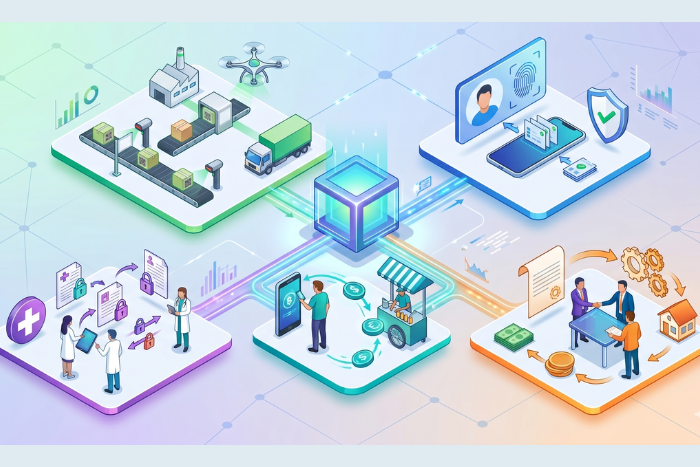
Blockchain isn’t just about Bitcoin anymore. While it may have started as the backbone of cryptocurrencies, today it’s quietly revolutionizing how businesses operate, often behind the scenes. From ensuring the origin of mangoes at Walmart to reimagining healthcare records with patient privacy in mind, blockchain is solving real-world problems across sectors.
If you still associate blockchain only with finance, it’s time to look again. As we highlighted in our Technology Trends in 2026 overview, blockchain is evolving into a foundational technology across industries. Blockchain use cases span finance, healthcare, supply chain, and more — enabling secure transactions, smart contracts, and transparent data across industries.
In this blog, we’ll unpack what blockchain really is, explore the key benefits it brings, and dive into how various industries are putting it to work. We’ll also look at real examples and why choosing the right development partner can make or break your blockchain journey.
What is Blockchain?
Blockchain is a shared digital ledger that records transactions across a distributed network of computers, making data tamper-resistant. Once something is written to the blockchain, it can’t be changed without consensus from the network. That makes it incredibly secure and transparent.
Imagine a Google Sheet that everyone in a business can see and update, but once a row is added, it can’t be altered or deleted without everyone agreeing. That’s the basic idea, just with better math and stronger encryption.
It started with Bitcoin, sure. But today, blockchain has moved far beyond crypto and into supply chains, healthcare, cybersecurity, manufacturing, and more.
Blockchain Architecture & Key Concepts
To truly understand blockchain’s potential, it’s essential to explore the core components that make up its architecture. Key among these are smart contracts, the backbone of blockchain automation, as well as the choice between private and public blockchains, and the growing need for interoperability.
Smart Contracts: The Engine Behind Automation
Smart contracts are self-executing contracts with the terms directly written into code. They automatically enforce and execute agreements when predefined conditions are met, eliminating the need for intermediaries. This automation leads to increased efficiency and reduced costs.
For instance, in real estate, smart contracts can automate the transfer of ownership once payment is confirmed, streamlining the buying process.
Private vs Public Blockchains: What Should You Choose?
Choosing between private and public blockchains depends on your organization’s needs:
- Public Blockchains: Open to everyone, decentralized, and transparent. Ideal for cryptocurrencies and public records.
- Private Blockchains: Restricted access, controlled by a single organization. Suitable for businesses requiring privacy and control.
Interoperability: Making Blockchains Talk to Each Other
As various blockchains emerge, interoperability becomes crucial. It allows different blockchain networks to communicate and share data seamlessly. It ensures that assets and information can move freely across platforms, enhancing user experience and system efficiency.
Projects like Polkadot and Cosmos are working towards achieving interoperability among blockchains.
What are the Benefits of Blockchain Technology?
So why is everyone from startups to Fortune 500 companies jumping onto the blockchain bandwagon? It comes down to a few key benefits:
1. Transparency and Traceability
When every transaction is visible to authorized participants, it builds trust. In supply chains, for instance, this means you can trace a product from its origin to the shelf, making it ideal for food safety, recalls, or verifying authenticity.
2. Security
Each block is linked to the previous one and secured with cryptographic hashes. That makes data manipulation virtually impossible without alerting the entire network. It’s a game-changer for fraud prevention and secure data sharing.
3. Decentralization
No single point of failure. No central authority calling the shots. This means more resilience, fewer bottlenecks, and reduced risk of censorship or data loss.
4. Efficiency and Cost Savings
By removing middlemen and automating workflows through smart contracts, blockchain can significantly reduce transaction times and operational costs.
These benefits aren’t just theoretical; they’re showing up in tangible, measurable ways across industries.
What are the use cases and real-world applications of Blockchain?
Let’s dig into where blockchain is actually being used. Below are some of the most exciting and high-impact use cases across various sectors.
Blockchain in Healthcare
From medical records to drug traceability, blockchain is helping healthcare become more secure, efficient, and patient-focused. Imagine being able to share your health history instantly with any specialist without worrying about lost files or data tampering, or knowing with certainty that the medication you’re taking is authentic and hasn’t been tampered with during shipment.
Explore more in our detailed article on Blockchain in Healthcare.
Blockchain in Digital Publishing & Content Ownership
Fake news, plagiarism, and improper licensing plague the digital publishing world. Blockchain introduces a single source of truth for digital rights, royalties, and ownership. Authors, artists, and publishers can register their content on-chain, ensuring transparent ownership and automated payouts when their content is reused.
Startups like Po.et and Audius are already making waves in this space, using blockchain to empower creators with greater control and monetization. Explore more through our detailed article on Blockchain in protecting Intellectual Properties.
Blockchain in Finance
Blockchain has redefined how we think about finance, not just through Bitcoin and Ethereum, but through real-time settlement systems, smart contracts, and DeFi. Whether it’s reducing fraud in cross-border payments or enabling peer-to-peer lending platforms, finance is one of the earliest and most advanced adopters of blockchain.
Want to see how it works in practice? Check out our deep dive on Developing FinTech Apps Using Blockchain Technology, where we break down key use cases and development strategies.
Blockchain in Information Services
Think of all the data we generate every second. Who owns it? Who has access to it? In information services, blockchain is helping create decentralized data marketplaces, where data sharing becomes more ethical and transparent.
Services like Ocean Protocol and Fetch.ai are enabling decentralized AI and data ecosystems powered by blockchain, letting individuals maintain control over their data and even monetize it.
Blockchain in Retail & eCommerce
For retailers, blockchain opens the door to transparent supply chains, verified product sourcing, and loyalty programs that actually work. Shoppers can trace where their product came from, how it was made, and if it’s ethically sourced.
Luxury brands like LVMH have already implemented blockchain (via the Aura Blockchain Consortium) to authenticate high-end goods, reducing counterfeiting and increasing customer trust.
Blockchain in Supply Chain
Supply chains are chaotic. Blockchain brings order. Blockchain in Supply Chain ensures every transaction, from raw materials to the shelf, is time-stamped and recorded. This makes it easy to trace back issues, prevent counterfeits, and ensure accountability throughout the product journey.
Blockchain in Manufacturing
In manufacturing, blockchain is used to track the life cycle of every component: who made it, when it was made, and under what conditions. This level of traceability helps companies quickly isolate problems during a recall and maintain compliance with industry regulations. It also plays a major role in reducing counterfeiting, especially in industries like automotive and aerospace.
Blockchain in Transportation and Logistics
In logistics, delays and misinformation cost billions. Blockchain brings transparency to shipping processes by logging each step in real-time, from loading docks to customs clearance to final delivery. It also helps reduce paperwork and human error.
Maersk, in partnership with IBM, launched TradeLens, a blockchain-based platform designed to digitize and track the global shipping ecosystem. It saw adoption by over 100 participants including port operators, customs authorities, and logistics providers.
Blockchain in Education and e-Learning
Diploma fraud is a real issue. Blockchain helps institutions issue verifiable certificates and academic records that can’t be faked or altered. Students can share their credentials with employers or other institutions instantly, without waiting weeks for paperwork.
Blockchain also supports micro-credentialing and lifelong learning, enabling secure records of smaller learning achievements that traditional transcripts don’t capture.
Universities like MIT and the University of Nicosia have already implemented blockchain-based certificate issuance.
Blockchain in Cybersecurity
With data breaches on the rise, blockchain offers a tamper-proof way to store critical information. Whether it’s securing login credentials, storing sensitive user data, or protecting digital communications, blockchain-based systems can offer decentralized and encrypted protection. The result? Fewer breaches, faster threat detection, and tighter control over sensitive systems.
Blockchain Technology: Real World Stories & Case Studies
Sometimes, the best way to understand blockchain’s impact is through real-world stories. Here are a few case studies:
Blockchain-based Digital Money Solution
In an effort to reimagine the digital economy, Mindfire Solutions built the Blockchain-based Digital Money Solution, a stable and predictable digital asset ecosystem. Designed from the ground up on a custom blockchain, this system allows users to invest in a token whose value increases algorithmically over time. What sets it apart is its price predictability, low transaction fees, and decentralized governance, managed by a legal foundation instead of a single entity.
Users can purchase the digital asset using cryptocurrencies like ETH, EOS, USDC, or USDT. All payments feed back into the ecosystem, redistributed to existing holders, ensuring growth and sustainability. The platform features a decentralized exchange (DEX), a shift from PoA to PoS consensus, governance modules, and other forward-looking components built with Substrate, Rust, Ethereum, and more.
It’s a powerful example of how blockchain can be used to create transparent, user-first financial ecosystems with long-term value.
Building Blocks – Blockchain for Humanitarian Aid
To improve the efficiency and transparency of humanitarian assistance, the World Food Programme (WFP) developed Building Blocks. This blockchain-based platform enables multiple aid organizations to collaborate using a shared, secure ledger. By reducing reliance on third-party financial service providers, the system cuts transaction costs and duplication of efforts.
Piloted in Jordan and expanded to countries like Bangladesh and Lebanon, the platform has facilitated over $325 million in cash transfers to refugees, while ensuring user privacy through encrypted identity management. In Ukraine, Building Blocks helped save $67 million by minimizing overlapping operations.
Built using private, permissioned Ethereum, this solution highlights how blockchain can drive efficiency, accountability, and cost savings in large-scale, multi-organization humanitarian missions.
Blockchain-Powered Supply Chain Transparency
To streamline its operations and strengthen supplier relationships, The Home Depot partnered with IBM to build a blockchain-based supply chain solution. This system provides real-time visibility into the status of orders, shipments, and receipts across its vast vendor network.
Key Benefit: The blockchain’s immutable ledger helped resolve supplier disputes faster by providing a shared, trustworthy version of transactional data. This significantly reduced administrative overhead and improved operational efficiency.
Example: When a delivery issue arises, both The Home Depot and its suppliers can immediately access a unified record, reducing back-and-forth communication and accelerating resolution times.
Built on: IBM Blockchain (Hyperledger Fabric), integrated with existing supply chain systems, this solution showcases how blockchain can enable trust, collaboration, and transparency at enterprise scale.
It’s a strong demonstration of blockchain’s potential to optimize traditional supply chains while enhancing partner accountability and customer satisfaction.
Decentralized Crypto Loan System
Mindfire Solutions introduced the Decentralized Crypto Loan System, a DeFi-based lending platform that allows users to unlock liquidity from their crypto assets without selling them. Here’s how it works: users deposit supported cryptocurrencies like BTC, ETH, USDC, or USDT into the platform, purchase a stable digital asset in exchange, and instantly receive a loan against that asset.
This digital asset remains locked for a year, after which the system deducts the loan amount plus a performance-based service fee. The remainder becomes accessible for withdrawal, offering a transparent and user-friendly way to grow crypto wealth. Key features include KYC/AML compliance, membership plans, crypto deposit/withdrawal, and a secure transaction tracking dashboard.
Built using Web3.js, Node.js, React, and integrated with tools like CoinGecko and Sumsub, the platform offers a streamlined experience backed by robust blockchain infrastructure.
Decentralized Messaging
With privacy and user control becoming increasingly critical, Mindfire Solutions developed a Decentralized Messaging component tailored for Web3. Unlike traditional messaging apps that lock users into closed ecosystems, this solution offers a silo-free, peer-to-peer communication layer that ensures full user sovereignty.
Built as an npm library, the messaging module supports end-to-end encryption, ENS-based identity mapping, and cross-platform interoperability. Users can securely send messages from one ENS name to another while maintaining full control over their data. There’s no central server, no single point of failure, and no compromise on privacy; even metadata is protected.
Leveraging technologies like Ethereum, Solidity, Ethers.js, Metamask, and Wallet Connect, this Web3-native messaging protocol is a forward-thinking alternative to centralized communication tools, designed for the decentralized internet era.
Emerging Blockchain Trends to Watch
Stay ahead by keeping an eye on these trends:
Decentralized Finance (DeFi): Financial services without intermediaries
DeFi uses blockchain and smart contracts to offer financial services like lending, borrowing, and trading without traditional intermediaries such as banks. This opens up global access to finance, reduces transaction costs, and enhances transparency. With user-controlled wallets and permissionless protocols, DeFi is reshaping the future of money. To know more, read our detailed article on DeFi : The Future of Finance.
Non-Fungible Tokens (NFTs): Unique digital assets representing ownership
NFTs are blockchain-based tokens that represent ownership of unique items ranging from digital art and music to virtual real estate and collectibles. Unlike cryptocurrencies, each NFT is one-of-a-kind, enabling verifiable digital scarcity. They empower creators to monetize their work directly and allow buyers to prove provenance and authenticity.
NFTs are transforming digital ownership and reshaping industries like gaming, entertainment, and publishing through blockchain-backed proof of originality and value.
AI and Blockchain Convergence
A key emerging trend is the fusion of AI and blockchain, enabling intelligent, decentralized systems. From AI-powered smart contracts to decentralized AI marketplaces and enhanced fraud detection, this synergy enhances automation, trust, and transparency. Blockchain also ensures data ownership and integrity in AI applications, addressing bias and accountability concerns. Explore this trend further in our detailed article on AI and Blockchain.
Central Bank Digital Currencies (CBDCs): Digital currencies issued by central banks
CBDCs are government-backed digital currencies designed to combine the benefits of fiat money with the efficiency of blockchain. Unlike cryptocurrencies, they are centrally regulated but offer faster, cheaper transactions, financial inclusion, and programmable monetary policies.
As nations explore CBDCs, they aim to modernize payment infrastructure while maintaining trust and stability. These digital currencies represent a strategic move toward a more resilient and future-ready financial system.
Blockchain in IoT:
Blockchain in IoT is revolutionizing how connected devices interact and share data. It ensures that every data transaction is securely recorded in a tamper-proof ledger. This reduces the risk of data breaches and unauthorized access across networks. By decentralizing control, blockchain adds an extra layer of trust to IoT ecosystems. It also enables better device authentication, system transparency, and secure automation.
As blockchain strengthens the IoT foundation, its real-world impact becomes especially evident in many sectors like healthcare, manufacturing, and logistics.
Explore more in our detailed article on IoT in Logistics
Challenges in Blockchain Adoption
Blockchain sounds amazing in theory, but bringing it into the real world? That’s where things get tricky.
While businesses across industries are exploring blockchain for its transparency, security, and decentralization, adoption isn’t always straightforward. Below are some of the most common (and often underestimated) challenges companies face when trying to implement blockchain-based solutions.
1. Regulatory Uncertainty
This is one of the biggest speed bumps. Blockchain operates across borders, but laws definitely don’t. What’s legal in Switzerland might be restricted in India. Data residency laws, crypto taxation, and evolving compliance frameworks make it tough for businesses to scale blockchain projects globally.
In heavily regulated sectors like finance and healthcare, companies must be extremely cautious to avoid non-compliance, even unintentionally. Governments are catching up, but the regulatory landscape is still a moving target.
2. Lack of Technical Expertise
Let’s face it: blockchain is not your average tech stack. It’s a complex ecosystem involving cryptography, distributed computing, consensus algorithms, and smart contracts. Finding developers who not only understand the tech but also how to build scalable, secure, and maintainable blockchain apps is still a challenge.
This skills gap becomes even more prominent when you throw in emerging frameworks like Hyperledger Fabric, Ethereum Layer 2s, or Cosmos SDK.
3. Scalability and Performance Limitations
Most public blockchains today still can’t match the speed or throughput of centralized systems. Ethereum, for example, can handle around 30 transactions per second (unless Layer 2s are involved), compared to Visa’s 24,000. Latency, high gas fees, and network congestion make blockchain a tough sell for high-volume applications, unless carefully architected.
4. Data Privacy and Storage
Contrary to popular belief, not everything belongs on the blockchain. On-chain data is immutable and publicly visible (especially on public chains). Storing sensitive information like medical records or PII without proper design choices can create more problems than it solves. Deciding what data stays on-chain vs. off-chain is critical, and often overlooked.
5. Interoperability Issues
Most blockchain networks operate in silos. Ethereum doesn’t talk natively to Bitcoin. Solana doesn’t connect out of the box with Hyperledger. Without bridges or middleware, building applications that span multiple chains or that connect with existing enterprise systems can be a serious challenge.
This is slowly changing with projects like Polkadot, Cosmos, and Chainlink CCIP, but interoperability is still a work in progress.
6. Poor User Experience
Let’s be honest, blockchain UX still leaves a lot to be desired. Most users don’t want to deal with private keys, wallet extensions, or signing transactions. Businesses need to abstract all that complexity behind clean, intuitive interfaces. That takes thoughtful design and deep understanding of user behavior, especially for customer-facing apps.
7. Cost of Development and Maintenance
Blockchain solutions aren’t cheap to build or maintain. You’re dealing with smart contract audits, constant security updates, evolving protocols, and expensive developer time. Plus, if you’re on a network with variable gas fees (like Ethereum), transaction costs can spike unexpectedly.
8. Legacy System Integration
Most organizations still rely heavily on legacy systems. Integrating blockchain into that stack without causing major disruptions is hard. You need APIs, middleware, and often custom connectors to make it all work together. This isn’t just a coding problem; it’s an architectural one.
Role of a Software Development Partner in Blockchain Development
Building real-world blockchain solutions takes more than just technical know-how. It demands a deep understanding of distributed systems, security, compliance, scalability, and user experience alongside domain knowledge to align with business goals.
A capable software development partner plays a crucial role in helping organizations navigate this complexity. From selecting the right blockchain framework to making key decisions like on-chain vs. off-chain data storage, smart contract security, and integration with legacy systems, a trusted partner ensures the architecture is sound and the solution is future-proof.
Mindfire Solutions brings all these capabilities under one roof, helping clients go from whiteboard to real-world impact with blockchain solutions tailored to their needs. With over 25 years of software engineering experience and a portfolio spanning complex enterprise systems, IoT platforms, AI integrations, and custom blockchain architectures, we bring deep technical fluency to every engagement. From architecting private ledgers and smart contract ecosystems to integrating blockchain layers into legacy ERP and supply chain systems, their teams have delivered production-grade solutions across industries like healthcare, logistics, education, retail, and finance.
Conclusion
Blockchain technology is rapidly moving beyond hype to become a critical component in the digital transformation of many industries. Its ability to provide transparency, enhance security, and enable decentralized automation is reshaping how businesses operate. However, successful blockchain adoption requires more than just technology. It demands strategic planning, deep technical expertise, and an understanding of regulatory and user challenges.
Partnering with the right software development team can make all the difference. A capable partner guides you through design decisions, compliance complexities, scalability challenges, and user experience considerations, ensuring your blockchain solution delivers measurable impact.
That’s where Mindfire Solutions comes in. It provides Custom Blockchain Development Services with proven experience across industries and a commitment to innovation and collaboration. Whether you’re just starting or scaling existing projects, we have the expertise to turn your blockchain vision into reality.
Contact Us today and let’s build something transformative, together.