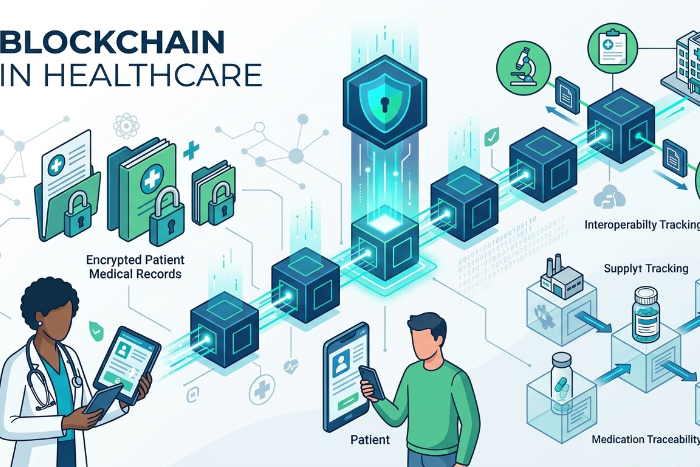
Let’s face it, healthcare is overdue for a digital overhaul. From disconnected records to endless paperwork and the constant threat of data breaches, the system is ripe for innovation. Enter blockchain, a technology poised to revolutionize healthcare from the inside out.
But what exactly does blockchain bring to the healthcare table? In this blog, we’ll break it all down: what blockchain is, how it’s being used in healthcare today, what benefits it unlocks, and the challenges we need to tackle before it can go fully mainstream.
What is Blockchain?
Blockchain is a digital ledger, a way to record data securely and transparently. But unlike traditional databases controlled by a central authority, blockchain is decentralized. Multiple computers (called nodes) each maintain a copy of the ledger, and they all agree on any changes through a consensus mechanism.
Each “block” in the chain contains a timestamp, data (like a patient record), and a link to the previous block, making it tamper-proof. If someone tries to alter even a single piece of data, the whole chain alerts the network.
What is Blockchain in Healthcare?
Blockchain in healthcare is the application of distributed ledger technology to manage sensitive medical data with greater security and transparency. Rather than storing patient records in centralized systems vulnerable to breaches, blockchain distributes data across a secure network, giving patients and providers greater control over who accesses their information and when.
Public blockchains (like Bitcoin) are open to all, but healthcare typically relies on permissioned blockchains, where only approved players (hospitals, labs, regulators) can participate. This hybrid model ensures both security and control.
What are the Benefits of Blockchain in Healthcare?
So, what’s the big deal? Why are organizations across the spectrum pouring resources into blockchain for healthcare?
It boils down to one thing: trust. In an industry built on confidentiality, precision, and life-or-death decisions, blockchain introduces a powerful foundation of transparency, security, and control. Let’s break down what that really means.
Data Security and Privacy
Healthcare is the top target for cyberattacks, and the numbers are staggering. According to the World Economic Forum, a single breach can cost a provider upwards of $10 million, not to mention the loss of patient trust, legal fallout, and reputational damage.
Blockchain dramatically raises the bar for security. Every piece of information is encrypted, time-stamped, and linked in a tamper-proof sequence. Instead of sitting in a vulnerable central server, data is distributed across a network, making it exponentially harder to hack.
And because access is tightly controlled through cryptographic keys, only authorized users, like doctors, patients, or payers, can view sensitive data. It’s like Fort Knox for your medical history.
Improved Interoperability
In many hospitals, interoperability is stuck in the dark ages. Blockchain offers a clean slate. With a shared, standardized ledger, different systems can seamlessly interact, whether it’s a hospital in Mumbai sharing lab results with a clinic in Delhi, or a rural health worker accessing vaccination data on the fly.
Instead of duplicating records or relying on manual handoffs, providers get a single, verifiable source of truth. That means faster diagnoses, fewer medical errors, and better outcomes, all without compromising patient privacy.
Patient-Centric Control
Traditionally, healthcare data has been controlled by institutions. Your records live in hospital databases or insurance portals, often inaccessible to you.
Blockchain flips the script. It gives ownership back to patients. With secure digital keys, individuals can decide who accesses their health data, when, and for how long. They can grant temporary access to a new specialist or revoke permissions with a click.
This approach aligns beautifully with privacy regulations like HIPAA in the U.S. or India’s ABDM (Ayushman Bharat Digital Mission) framework. It empowers people to take charge of their own health information, without needing to understand the tech behind it.
Immutable Audit Trails
In healthcare, knowing who did what, and when isn’t optional, it’s essential. Whether it’s a prescription being altered or an insurance claim being filed, every action needs to be traceable.
Blockchain logs every interaction immutably. That means you can’t delete or change a record without leaving a digital footprint. This creates an ironclad audit trail, ensuring accountability across the board, from doctors and pharmacies to insurers and researchers.
Regulators love it. So do compliance teams. And in a world where fraud and medical errors cost billions, this kind of visibility is a game-changer.
Cost Savings and Operational Efficiency
Let’s talk money. The healthcare system bleeds resources through administrative overhead, billing disputes, and redundant processes. Blockchain helps plug these leaks.
By automating workflows through smart contracts (self-executing agreements), tasks like claims processing, prior authorizations, and record reconciliation can run hands-free.
Hospitals don’t need to chase paperwork. Insurers don’t need to cross-check manually. And patients benefit from quicker reimbursements and cleaner billing. Industry estimates suggest blockchain could slash healthcare costs by billions annually, just by cutting out inefficiencies and fraud.
Inclusion and Global Access
One of blockchain’s most overlooked superpowers is accessibility. Because it doesn’t rely on centralized infrastructure, blockchain solutions can thrive even in low-resource settings.
This makes it a perfect fit for rural or underserved areas. Imagine a village clinic in Kenya using a blockchain-powered mobile app to log patient visits, track immunizations, or verify a health worker’s credentials, without needing an expensive IT setup.
With support for low-bandwidth environments and built-in data integrity, blockchain can bridge the digital divide and bring quality healthcare to the people who need it most.
What are the Real-World Applications of Blockchain in Healthcare?
Blockchain isn’t just a futuristic idea, it’s already in action across several healthcare domains. Let’s explore where it’s making an impact.
Securing Health Records (EHR/EMR)
A long-standing challenge in healthcare is interoperability. How do we get hospitals, clinics, and labs to share patient data without compromising privacy?
Blockchain offers a solution. Rather than storing raw data on-chain, healthcare systems can log pointers or hashes of data, ensuring that the record hasn’t been altered. Estonia, for example, has implemented blockchain-backed e-health records for its entire population. Every access or change is recorded immutably.
In India, researchers have proposed similar blockchain-backed systems for the Ayushman Bharat initiative, where patients control access to their records via secure digital keys.
Pharmaceutical Supply Chain Transparency
Counterfeit drugs cost the pharmaceutical industry billions every year and more importantly, they risk lives. Blockchain enables full traceability of medicines from manufacturer to patient.
Take MediLedger, for instance. This consortium of pharma giants (like Pfizer and Genentech) tracks drug batches using blockchain to prevent fraud and ensure compliance with the FDA’s Drug Supply Chain Security Act (DSCSA).
Even in vaccine distribution (think COVID-19), blockchain has helped monitor storage conditions and distribution paths to prevent mishandling or spoilage.
Clinical Trials and Research Integrity
Clinical trials require meticulous data management and traceability. Blockchain can record informed consent, protocol adherence, and trial outcomes immutably thereby reducing fraud, ensuring transparency, and improving regulatory confidence.
It also helps with patient recruitment. Imagine a decentralized system that connects eligible patients with researchers while keeping their identities private. In countries like India, with vast and diverse populations, this could be a game-changer.
Insurance, Claims, and Billing
Smart contracts i.e. self-executing rules coded onto the blockchain, can streamline health insurance claims. No more duplicate claims or endless processing.
Anthem, a major U.S. health insurer, piloted a blockchain-based app where users could grant time-limited access to their health records via QR codes. That’s patient empowerment in action – simple, secure, and efficient.
IoT and Remote Monitoring
Internet-of-Medical-Things (IoMT) devices generate huge volumes of patient data. Blockchain ensures this data remains authentic and traceable. Whether it’s a heart monitor or a glucose sensor, the readings can be logged securely, providing doctors with trusted insights.
For more on how connected systems handle massive healthcare data streams, explore our blog on Data Engineering for IoT Applications.
Public Health and Pandemic Response
Blockchain’s transparency proved valuable during COVID-19. In Africa, platforms like Snark Health and AID:Tech used blockchain to distribute vaccines and aid effectively. The audit trail ensured accountability and trust, especially critical in times of crisis.
Healthcare Credentials and Licensing
Credential fraud among health professionals is more common than you’d think. Platforms like VerifyMed use blockchain to maintain digital credentials, making it easy to validate a doctor’s qualifications across borders.
In India, such solutions could streamline doctor verification in both urban and rural settings.
Real-Life Success Stories of Implementing Blockchain in Healthcare
Still wondering if blockchain in healthcare is just a buzzword? Let’s look at some real projects:
- Estonia: The first country to implement blockchain in national health records. Citizens can track who accessed their data and why – an unprecedented level of transparency.
- Anthem (USA): Empowered patients to share health records with doctors via a blockchain-powered app. Control stayed with the patient, not the insurer.
- MediLedger Consortium: Helping pharmaceutical companies meet traceability mandates, cutting down counterfeit risk, and improving safety.
- Vaccine Distribution in Africa: Organizations like the World Economic Forum and WHO cited blockchain platforms in Kenya and Tanzania that ensured proper vaccine storage and equitable distribution.
- Genomic Data Sharing: Platforms like Nebula Genomics let individuals monetize their genetic data securely, fueling research while protecting privacy.
The Future of Blockchain in Healthcare
As the healthcare industry embraces digital transformation, blockchain is moving from pilot projects to becoming a foundational technology for secure, patient-first systems. But what does that future actually look like?
Here are the key trends and innovations to keep an eye on:
AI and Blockchain Integration
Artificial Intelligence is only as good as the data it consumes. Garbage in, garbage out, right?
That’s where blockchain steps in. By ensuring that health data is authentic, time-stamped, and tamper-proof, blockchain provides a clean data pipeline for AI systems.
This is critical for areas like:
- Predictive analytics (e.g., forecasting patient readmissions)
- Personalized treatment plans
- Early disease detection
For example, an AI model analyzing patient trends from wearables can trust blockchain-validated inputs, meaning more accurate diagnoses and fewer false alarms.
It’s a powerful combination: AI brings intelligence, blockchain brings integrity. For a deeper dive into how these technologies work together across industries, check out our article on AI and Blockchain: The Future of Decentralized Intelligence.
Decentralized Clinical Trials
Clinical trials are ripe for reinvention. They’re complex, slow, and often limited by geography or administrative overhead.
Enter blockchain-powered decentralized trials. Imagine a system where:
- Patient consent forms are securely recorded and time-stamped
- Payments and reimbursements are triggered automatically via smart contracts
- Trial data is transparently logged in real-time, across multiple global sites
This model not only speeds up research but also ensures regulatory compliance and auditability from day one.
It’s a leap toward faster drug development, reduced fraud, and more inclusive trials, especially in emerging markets.
Blockchain as a Utility Layer
Just like websites today run on protocols like HTTP and TCP/IP, future healthcare apps may all run on a shared blockchain utility layer. Instead of building custom systems from scratch, developers could:
- Plug into permissioned blockchain networks
- Use standardized APIs for patient identity, consent, and record verification
- Anchor data hashes on-chain, while storing sensitive files off-chain
This interoperability dream isn’t far off. Technologies like Hyperledger Fabric, Corda, and Ethereum side chains are already being tested by hospitals and health consortia.
In the long run, this will make it easier (and cheaper) to build secure, connected health apps that work across providers, payers, and even countries.
Privacy-First Innovations
How do you prove someone qualifies for a clinical trial, say, a diabetic patient over 50, without actually revealing their personal details?
That’s where zero-knowledge proofs (ZKPs) come in. These cryptographic techniques let systems verify facts without disclosing the underlying data. In healthcare, this could enable:
- Anonymous eligibility checks
- Privacy-preserving data sharing
- Secure statistical research on populations
As privacy laws tighten and patients demand more control, ZKPs and similar tools will become cornerstones of responsible data use.
Regulation and Government Adoption
Governments aren’t just watching from the sidelines, they’re starting to build blockchain into public health frameworks.
Take India’s National Digital Health Mission (NDHM). As it creates a national health ID and digitized records, blockchain could play a key role in:
- Securing decentralized health repositories
- Managing consent workflows
- Preventing fraud in public schemes
Other countries are exploring regulatory sandboxes, allowing health-blockchain pilots to test compliance with laws like HIPAA, GDPR, and India’s DISHA. As these policies mature, expect blockchain to evolve from “nice-to-have” to regulatory best practice.
Patient-Owned Health Economies
Here’s a bold idea: what if patients didn’t just control their health data, but could profit from it, ethically and transparently? That’s the promise of tokenized health data economies, where patients can:
- Share anonymized data with researchers
- Track where and how their data is used
- Earn rewards, discounts, or tokens in return
It flips the current model on its head, where hospitals and tech giants benefit from your data, by turning patients into active participants in the value chain. In regions with strong digital identity systems (like India’s Aadhaar + ABDM), this vision is within reach.
Challenges to Keep in Mind
Of course, it’s not all smooth sailing. Blockchain in healthcare still faces hurdles:
- Compliance Conflicts: Laws like GDPR and HIPAA sometimes clash with blockchain’s immutability. Designing systems that satisfy both legal and technical requirements is tricky but solvable.
- Scalability: Public blockchains struggle with throughput. Healthcare data is massive. Solutions like permissioned chains or sharding can help, but they add complexity.
- Legacy Integration: Most hospitals still use outdated IT. Integrating blockchain requires significant retooling and change management.
- Security Risks: While blockchain itself is secure, poor key management or buggy smart contracts can still pose risks. Think: lost keys means lost access to health records.
- Governance: Who controls a healthcare blockchain network? Who decides who joins or what updates are made? Clear rules and fair representation are critical.
- Digital Divide: Any blockchain solution must be inclusive. Not every patient has access to a smartphone or stable internet, especially in rural or underserved areas.
Conclusion: Turning Trust into Transformation
Blockchain is not just another tech fad. It’s a foundational shift in how healthcare can manage trust, privacy, and interoperability. Is it a magic bullet? No. But it offers something sorely lacking in many health systems: transparency, security, and patient control.
As governments, insurers, and providers test and scale blockchain solutions, now is the time for healthcare organizations to start exploring what this technology can do for them. From securing patient records and streamlining insurance claims to enabling global clinical trials and fighting counterfeit drugs, blockchain offers a new way to build trust, ensure transparency, and empower patients.
That said, adopting blockchain isn’t a one-click upgrade. It requires the right strategy, strong domain understanding, and deep technical expertise. The challenges like interoperability, privacy compliance, and integration with legacy systems, demand tailored solutions.
That’s where we come in. At Mindfire Solutions, we help healthcare organizations harness the power of blockchain through Custom Blockchain Development Services, designed to meet the unique needs of patient-first ecosystems. Whether you’re looking to build secure patient portals, digitize consent management, or launch a full-scale blockchain network across providers, we’ve done it.
If you’re ready to explore how blockchain can fit into your digital health roadmap, Contact Us today.