Cloud eCommerce 1

Cloud-Powered eCommerce: Building Scalable, Resilient Digital Businesses

Introduction

Cloud-powered eCommerce is no longer just a technology choice; it is a business strategy for growth, resilience, and customer trust. For CEOs and owners, the real question is not whether your online store looks modern, but whether the entire digital business can scale, adapt, and perform under pressure.

Today’s eCommerce success extends far beyond the storefront. A sleek website or mobile app may attract customers, but long-term performance depends on the reliability of the systems behind it: inventory, order management, pricing, payments, logistics, analytics, and customer data. Without a strong digital foundation, growth often creates friction instead of value.

That is why technology has become an enabler of customer experience, operational efficiency, and scalability. The businesses that win are the ones that treat technology as the backbone of their operating model, not just an IT expense. In that context, a well-designed Cloud-based eCommerce strategy can help leaders grow faster while staying resilient.

The Tech Foundation Behind a Successful eCommerce Business

1. Customer-facing platforms that shape the buying experience

The most visible part of any eCommerce business is the customer-facing platform. This includes the website, mobile application, search experience, product discovery, checkout flow, and post-purchase communication. These touchpoints shape how customers perceive the brand, how quickly they convert, and whether they return.

For CEOs, the strategic value lies in more than design. A strong digital experience must also support personalization, responsiveness, and consistency across channels. Customers expect products to load quickly, recommendations to feel relevant, and checkout to be seamless regardless of device or traffic conditions.

2. Internal business applications that keep operations moving

Behind every smooth online transaction is a set of internal applications that keep the business functioning. Inventory and order management systems ensure that what appears available online is actually in stock and deliverable. Customer, product, and pricing management tools keep business rules aligned across sales channels.

In addition, enterprise systems such as ERP, CRM, payment gateways, logistics platforms, and fulfillment tools must work together. When these systems are fragmented, teams spend time reconciling data instead of serving customers. When they are connected, the business gains a single operational view that supports better decisions and fewer errors.

3. Integration and Scalability

Integration is what turns separate tools into a cohesive operating system. Customer-facing and internal systems must communicate in real-time or near real-time to avoid delays, overselling, pricing mismatches, and fulfillment issues. The more channels and markets a company serves, the more important this connected foundation becomes.

Scalability matters because growth should not degrade performance. A business that adds traffic, SKUs, new geographies, or seasonal demand should not need to rebuild its technology stack every time it expands. The right architecture allows the company to grow without compromising speed, stability, or customer satisfaction.

How Cloud Technology Enables Modern eCommerce

  • Scalability on Demand: One of the most compelling advantages of Cloud-powered eCommerce is the ability to scale resources up or down as demand changes. This is especially valuable during holiday peaks, promotional campaigns, product launches, or unexpected viral traffic. Instead of overbuilding infrastructure for every possible scenario, cloud environments let businesses respond to actual demand. For owners, this means better capital efficiency. You can invest in growth without carrying the full cost of idle infrastructure. It also means the business is more prepared for volatility, which is now a normal part of digital commerce rather than an exception.
  • Performance & Availability: In eCommerce, seconds matter. Slow page loads, downtime, and failed transactions directly affect revenue and trust. Cloud environments are designed to support high availability, distributed performance, and fault tolerance, helping reduce the risk of service interruptions. Reliable performance is not only a technical advantage; it is a customer experience advantage. When shoppers can browse, compare, and purchase without friction, conversion improves. When the system remains available during peak moments, the brand earns confidence and repeat business.
  • Faster App Development and Deployment: Modern commerce requires constant improvement. Promotions change, customer expectations evolve, and competitors move quickly. Cloud-native development, automation, and continuous delivery pipelines make it possible to release updates faster and more safely. This speed matters at the executive level because it shortens the time between business insight and market action. Whether the company needs to test a new checkout flow, roll out a regional feature, or integrate a new payment provider, cloud-based delivery models reduce delays and improve agility.
  • Data, Analytics & AI readiness: eCommerce creates valuable data at every step of the customer journey. Browsing behavior, purchase history, inventory movement, returns, support tickets, and pricing patterns all contain insight. Cloud platforms make it easier to bring these data sources together in ways that support analytics, personalization, and AI-driven capabilities. For CEOs, this is where cloud becomes a growth multiplier. Data can reveal which products drive repeat purchases, where customers abandon carts, and which channels produce the best margins. AI can then help improve product recommendations, demand forecasting, service automation, and dynamic decision-making.
  • Security, Resilience and Business Continuity: Trust is essential in digital commerce. Customers expect secure payments, protected personal data, and uninterrupted service. Cloud environments support modern security controls, encryption, access governance, automated monitoring, backup, and disaster recovery practices that strengthen resilience. Business continuity is especially important when eCommerce becomes a primary revenue engine. A single outage or data incident can impact sales, reputation, and customer loyalty. A resilient cloud strategy reduces exposure and ensures the business can recover quickly when disruptions occur.

……………………………………………………………………………………………………..
To understand how serverless computing can be leveraged for eCommerce, refer to Serverless eCommerce for Agile and Scalable Platforms — an article on the shift of responsibility of server management and the ensuing advantages.
……………………………………………………………………………………………………..

Building a Cloud-enabled eCommerce Technology Ecosystem

1. Cloud Infrastructure and Application Architecture

A strong Cloud eCommerce Solution starts with the right architecture. This means designing systems for reliability, elasticity, and maintainability from the beginning, rather than simply moving old applications into the cloud unchanged. The goal is to create a platform that can support both current operations and future expansion. Leaders should think in terms of business capabilities, not just servers and software. The architecture should allow teams to launch faster, integrate more easily, and adapt to changing customer demands without creating unnecessary complexity.

2. APIs and System Integration

APIs are the connective tissue of modern eCommerce. They allow customer-facing platforms, ERP systems, payment providers, logistics services, and analytics tools to exchange data efficiently. A well-integrated environment reduces manual work, improves accuracy, and creates a more unified customer and operational experience. When systems communicate through clear integration layers, the business can add new tools without disrupting core operations. This flexibility is crucial for companies that plan to expand into new markets, channels, or fulfillment models.

3. Microservices and Containerization

Microservices and containerization help businesses break large applications into smaller, more manageable components. This approach supports independent updates, better fault isolation, and improved scalability. For growing eCommerce businesses, that means new features can be launched without affecting the entire platform. Executives benefit because these modern patterns reduce risk and increase speed. Teams can innovate continuously while maintaining operational stability, which is essential in a competitive market where customer expectations change quickly.

4. Data Platforms and Analytics

Data platforms bring together information from sales, operations, marketing, customer service, and finance. This creates a more complete picture of business performance and customer behavior. With the right analytics layer in place, leaders can move from reactive reporting to proactive decision-making. A cloud-enabled data strategy also supports personalization and forecasting. It can help identify high-value customers, predict demand trends, improve inventory planning, and optimize pricing strategies. That combination of insight and action is one of the most powerful benefits of cloud adoption.

5. DevOps and Continuous Delivery

DevOps practices connect development and operations so teams can deliver value faster and with fewer errors. Continuous delivery extends that capability by automating testing, deployment, and monitoring. Together, these practices help eCommerce businesses respond quickly to market needs while maintaining quality. For business owners, this means less time waiting on technical releases and more time executing on strategy. It also means technology can keep pace with business ambition, rather than slowing it down.

Conclusion

Cloud-powered commerce is about much more than hosting a store online. It is about building a digital business that can scale confidently, stay resilient under pressure, and deliver better customer experiences at every stage of growth. The companies that succeed will be those that connect customer-facing platforms with the operational systems behind them. For CEOs and owners, the opportunity is clear. A modern Cloud-based eCommerce model can improve agility, reduce operational friction, strengthen data-driven decision-making, and support long-term continuity. In a market where customer expectations move quickly and competition is relentless, cloud is not just an infrastructure decision. It is a foundation for durable growth.

If you are seeking out a technical partner that offers expertise in cloud computing alongside deep understanding of eCommerce, Mindfire is the right choice. From architecture design to post-deployment support, we ensure speed, scalability, and security at every step. Explore our Cloud Application Development Services to see how we can turn your vision into a robust, future-ready solution. Contact us today to discuss your need.


Spread the love
  •  
  •  
  •  
  •  
  •  
  •  
  •  
  •  
  •  
AI and Blockchain

Decentralized Intelligence: AI and Blockchain Convergence

The conversation around AI and Blockchain Integration has moved far beyond experimentation. For CEOs and owners, the real question is no longer whether these technologies matter, but how they can work together to create durable competitive advantage.

AI brings speed, pattern recognition, and decision-making at scale. Blockchain brings trust, verification, and shared control across participants who do not necessarily trust one another. AI and Blockchain convergence point towards a new model of decentralized intelligence: systems that can think, act, and coordinate with less friction and more accountability. This matters because the next wave of digital transformation will not be won by intelligence alone. It will be won by intelligence that can be trusted, governed, audited, and extended across ecosystems. Continue reading Decentralized Intelligence: AI and Blockchain Convergence

Spread the love
  •  
  •  
  •  
  •  
  •  
  •  
  •  
  •  
  •  
Cloud Infrastructure for Banks

Modernizing Banking Infrastructure with Cloud Computing

Cloud computing has evolved from a cost-saving technology into a strategic foundation for banking transformation. Financial institutions are under constant pressure to deliver seamless digital experiences, respond to fintech competition, strengthen resilience, and comply with evolving regulations. Legacy banking systems, while reliable, often limit innovation because they are expensive to maintain, difficult to scale, and slow to adapt to changing business requirements.

Cloud computing enables banks to modernize these legacy environments by providing scalable infrastructure, flexible deployment models, advanced security capabilities, and faster software delivery. Today, cloud adoption is no longer viewed as a technology upgrade alone; it is a business initiative that helps banks improve operational efficiency, accelerate product innovation, and deliver superior customer experiences. With most financial institutions already migrating at least part of their workloads to the cloud, modernization has become a key differentiator for long-term competitiveness.

……………………………………………………………………………………………………..

Key Drivers Behind Cloud Adoption in Banking?

Cloud adoption is being driven by a combination of customer expectations, market dynamics, and operational priorities. The following factors continue to shape modernization initiatives across the banking sector.

1. Digital-first customer expectations

Customers expect secure, always-available, and personalized banking experiences across mobile, web, and branch channels. Cloud infrastructure enables banks to support these expectations with improved availability, faster performance, and continuous service delivery.

2. Innovation and competitive pressure

Fintech firms and digital-native banks introduce new products at a rapid pace. Cloud-native development practices enable traditional banks to shorten release cycles, experiment with new services, and respond quickly to changing market demands.

3. Operational efficiency

Cloud’s consumption-based pricing model helps optimize infrastructure costs while reducing the complexity of managing large on-premises environments. Resources can be scaled based on demand, allowing technology teams to focus more on innovation than infrastructure maintenance.

4. Business resilience

Modern cloud platforms provide built-in redundancy, disaster recovery, and high availability. Multi-region deployments improve business continuity while reducing the risk of service disruption.

……………………………………………………………………………………………………..

Modernizing Core Banking Infrastructure?

One of the most significant impacts of cloud computing is the modernization of core banking platforms. Rather than replacing legacy systems overnight, many institutions adopt a phased modernization strategy that balances innovation with operational stability.

  • Core banking transformation: Banks are redesigning legacy core systems using modular, API-first architectures that improve integration, flexibility, and future scalability.
  • Cloud-native development: DevOps, CI/CD pipelines, containerization, and Infrastructure enable development teams to provision environments rapidly and release new capabilities with greater confidence.
  • Elastic scalability: Cloud infrastructure automatically adjusts computing capacity during seasonal demand spikes, such as tax filing periods, festive shopping seasons, or IPO activity, ensuring consistent customer experiences.
  • Backup and disaster recovery: Geo-redundancy, automated backups, and failover mechanisms strengthen operational resilience while supporting regulatory expectations for business continuity.
  • Internal IT modernization: Many banks initially migrate internal applications such as HR, payroll, collaboration, and document management to the cloud, freeing IT resources to focus on customer-facing innovation.

……………………………………………………………………………………………………..
For a full breakdown of cloud development approaches, architectures, and implementation best practices, refer to The Ultimate Guide to Cloud Application Development — a foundational piece for understanding how to tackle complexity and future-proof your cloud strategy.
……………………………………………………………………………………………………..

Business Benefits of Cloud Adoption

  • Cost efficiency: Cloud infrastructure reduces capital expenditure and enables better utilization of technology resources through a pay-as-you-go model.
  • Scalability and flexibility: Banks can scale infrastructure dynamically without investing in excess hardware, ensuring optimal performance during fluctuating transaction volumes.
  • Faster time-to-market: Cloud-native engineering and DevOps practices shorten development cycles, allowing banks to launch new digital products more quickly.
  • Enhanced customer experience: High availability, improved application performance, real-time analytics, and personalized services contribute to stronger customer engagement.
  • Innovation: Cloud platforms simplify experimentation with AI, machine learning, analytics, blockchain, and open banking initiatives, enabling banks to develop new revenue opportunities.
  • Security and compliance: Leading cloud providers offer advanced identity management, encryption, continuous monitoring, and compliance frameworks that support banking regulations.

……………………………………………………………………………………………………..

Cloud Deployment Models?

Selecting the appropriate deployment model depends on regulatory requirements, workload sensitivity, scalability needs, and long-term technology strategy.

1. Public Cloud

Ideal for analytics, development environments, customer-facing applications, and workloads requiring rapid scalability. Sensitive transactional systems typically require additional governance controls.

2. Private Cloud

Provides greater control over infrastructure and data, making it suitable for highly regulated workloads and sensitive information.

3. Hybrid Cloud

Combines private and public cloud environments, allowing banks to retain critical workloads on private infrastructure while leveraging public cloud for analytics, digital channels, and elastic capacity.

4. Multi-Cloud

Enables organizations to leverage multiple cloud providers, improving resilience and reducing dependency on a single vendor. Successful adoption requires mature governance and operational capabilities.

Cloud computing is redefining how banks build, operate, and evolve digital services. Beyond infrastructure modernization, it enables greater agility, resilience, operational efficiency, and continuous innovation. Financial institutions that invest in cloud-native capabilities today will be better positioned to respond to changing customer expectations and emerging market opportunities. 

……………………………………………………………………………………………………..

Mindfire Solutions partners with banks and fintech organizations to modernize legacy systems through secure, scalable, and business-focused cloud engineering. Our capabilities span cloud consulting, application modernization, cloud-native software development, DevOps, quality engineering, integration, and ongoing support. We possess the agility, precision and technical acumen in cloud application development services to fulfill your cloud journey demands. Contact us today to discuss your cloud strategy.


Spread the love
  •  
  •  
  •  
  •  
  •  
  •  
  •  
  •  
  •  
Pitfalls in Cloud Computing

Pitfalls in Cloud Computing

Cloud Software Services have become the foundation of modern digital products, enterprise platforms, and business operations. Organizations adopt cloud technologies to improve agility, accelerate innovation, scale faster, and reduce infrastructure management burdens. Yet cloud success is far from guaranteed. Many organizations discover that moving to the cloud introduces a new set of operational, financial, security, and governance challenges that can offset expected benefits if not addressed proactively.

Understanding these pitfalls is essential for technology leaders responsible for cloud transformation. We examine the most common challenges that derail cloud initiatives and outline practical measures to reduce risk while maximizing value.

……………………………………………………………………………………………………..

What are the primary Cloud Computing Challenges ?

Despite its many benefits, cloud computing challenges can slow down adoption and disrupt operations if not addressed early. Let’s look at some of the major ones below.

1. Performance and Latency Challenges

Cloud infrastructure offers elastic scalability, but application performance still depends on architecture, network design, and data placement. Many organizations assume that cloud resources alone guarantee responsiveness. In reality, performance issues often become more pronounced in distributed environments.

Latency is particularly problematic for customer-facing applications, transactional systems, and analytics workloads that depend on frequent service interactions. Every additional network hop introduces delay and increases the risk of bottlenecks. Poor API design, inefficient database queries, and excessive synchronous communication can significantly impact user experience.

Another common issue arises when compute resources and databases are deployed far from end users. Centralizing data in one geography while serving users globally often leads to slower response times and reduced application performance.

Performance optimization should be treated as a continuous process. Organizations must regularly monitor throughput, latency, caching effectiveness, database contention, and service interactions under real-world workloads. Cloud scalability is most effective when supported by disciplined performance engineering.


2. Downtime and Reliability Risks

Many enterprises mistakenly assume that using a hyperscale cloud provider automatically guarantees high availability. While cloud platforms provide resilient infrastructure, application reliability ultimately depends on how systems are designed, deployed, monitored, and recovered. Outages frequently stem from single-region deployments, weak fault isolation, poor change management, fragile dependencies, and incomplete disaster recovery planning. In highly automated environments, a small configuration error can quickly propagate across systems and disrupt critical services.

Reliability is not achieved through redundancy alone. Backup strategies must be accompanied by tested restoration procedures. Failover mechanisms should be exercised regularly. Recovery objectives should be clearly defined and validated through realistic drills. The business impact of downtime extends well beyond technical disruption. Revenue loss, SLA penalties, customer churn, operational delays, and reputational damage can significantly outweigh the direct cost of an outage. Organizations that succeed in the cloud design for failure from the outset and continuously validate their resilience strategies.

……………………………………………………………………………………………………..
For a full breakdown of cloud development approaches, architectures, and implementation best practices, refer to The Ultimate Guide to Cloud Application Development — a foundational piece for understanding how to tackle complexity and future-proof your cloud strategy.
……………………………………………………………………………………………………..

3. Compliance and Regulatory Complexity

Compliance remains one of the most underestimated aspects of cloud adoption, especially for organizations operating across multiple jurisdictions or handling regulated data. Cloud environments introduce additional complexity around data residency, retention policies, encryption requirements, auditability, and access logging. Regulatory frameworks such as GDPR, HIPAA, PCI DSS, and SOC 2 require organizations to demonstrate ongoing compliance rather than simply claim adherence.

The shared responsibility model further complicates governance. Cloud providers secure the underlying infrastructure, but customers remain responsible for configuring services correctly, protecting data, managing access controls, and maintaining compliance evidence.

Compliance programs commonly break down because of unclear data classification, inadequate logging, uncontrolled data movement across regions, weak access governance, and insufficient oversight of third-party integrations. Organizations that treat compliance as an architectural and operational requirement rather than an audit exercise are better positioned to avoid costly failures.


4. Security and Privacy Concerns

Cloud security challenges are typically caused by misconfigurations rather than weaknesses in cloud platforms themselves. As cloud environments grow in scale and complexity, the number of opportunities for human error increases. Common security issues include overly broad permissions, exposed APIs, misconfigured storage services, weak secrets management, and vulnerable CI/CD pipelines. Privacy risks emerge when sensitive data is inadequately protected, improperly retained, or inadvertently exposed through logging and sharing practices.

Modern cloud architectures rely heavily on automation, containers, serverless functions, APIs, and infrastructure-as-code. While these technologies improve speed and agility, they also create additional attack surfaces. Threat actors increasingly target identities, credentials, tokens, and software supply chains instead of infrastructure alone.

Security must therefore be integrated throughout the software delivery lifecycle. Organizations should adopt least-privilege access models, continuous monitoring, automated policy enforcement, and secure development practices to reduce risk.


5. Managing Multi-Cloud and Hybrid Environments

Many enterprises pursue multi-cloud or hybrid strategies to reduce vendor dependency, satisfy regulatory requirements, or preserve existing investments. While these objectives may be valid, operating multiple platforms introduces significant complexity.

Different cloud providers use different service models, management tools, pricing structures, and operational conventions. Hybrid environments add further complexity by requiring seamless integration between cloud services and on-premises systems.

Without a clear operating model, organizations often struggle with fragmented visibility, inconsistent policy enforcement, duplicate tooling, and higher operational overhead. Engineering teams may spend more time maintaining compatibility than delivering business value. Multi-cloud can provide flexibility when driven by specific technical or regulatory requirements. However, adopting multiple platforms without a clear strategy often creates unnecessary complexity and increases long-term costs.

6. Vendor Lock-In Risksy

Vendor lock-in becomes increasingly important as organizations adopt proprietary cloud services. Managed databases, event platforms, AI services, identity systems, and orchestration tools can significantly accelerate development. However, they can also create long-term dependency.

The challenge is not that proprietary services are inherently bad. In many cases, they provide substantial operational benefits. The risk arises when organizations adopt them without understanding the future implications. Changes in pricing, service availability, contractual terms, or strategic direction can become difficult to manage when migration options are limited. Vendor dependence may also reduce negotiating leverage and constrain future architectural choices.

Organizations should carefully evaluate portability requirements and document critical dependencies. The goal is not to avoid cloud-native services but to make informed trade-offs based on business priorities.


7. Cost Overruns and Budget Complexity

One of the biggest misconceptions about cloud adoption is that it automatically lowers costs. While cloud platforms eliminate large upfront infrastructure investments, they replace predictable capital expenditure with variable operating expenditure. This flexibility is valuable, but it also makes overspending easier.

Cloud costs frequently increase because of overprovisioned resources, idle environments, storage sprawl, excessive data transfer, duplicated services, and unmanaged growth across teams. Organizations often underestimate the cost of observability platforms, security tooling, backups, disaster recovery configurations, and premium managed services.

The challenge extends beyond total spending. As multiple teams provision resources independently, cloud billing becomes increasingly difficult to understand. Forecasting costs, attributing expenses to business units, and identifying inefficiencies become significant operational challenges.

Common causes of cloud cost escalation include always-on environments that could be autoscaled, poor tagging practices, excessive inter-region traffic, duplicated services, and weak accountability for resource consumption. Successful organizations address these issues by embedding FinOps practices early and treating cloud cost management as an ongoing operational discipline.


8. Talent and Team Readiness

Technology alone does not determine cloud success. Organizational readiness plays an equally important role. Cloud-native environments require expertise in distributed systems, automation, observability, security engineering, cost optimization, and modern operational practices. Teams accustomed to traditional infrastructure models often struggle to adapt without targeted training and support.

Skill gaps create risks throughout the technology stack. Developers may deploy inefficient workloads. Operations teams may not fully understand cloud-native failure modes. Security teams may lack familiarity with infrastructure-as-code and automated deployment pipelines.

Organizations must also adapt to the cloud’s shared responsibility model. Product teams, platform teams, security teams, vendors, and governance functions all share accountability. When ownership is unclear, operational blind spots emerge and incident response becomes slower and less effective. External partners can accelerate cloud adoption and fill capability gaps, but organizations still need sufficient internal expertise to make strategic decisions and govern their environments effectively.

……………………………………………………………………………………………………..

Best Practices to Mitigate Cloud Risks

Preventing cloud failures requires more than technology investments. Successful organizations establish operating models that align architecture, governance, security, compliance, cost management, and organizational capability. 

  • Design for resilience by eliminating single points of failure and testing recovery processes regularly.
  • Implement strong security controls through encryption, identity management, least-privilege access, and network segmentation.
  • Adopt cloud-native services strategically while balancing convenience against portability and long-term maintainability.
  • Strengthen data governance through clear policies for classification, retention, residency, lineage, and deletion.
  • Invest in cloud-specific training so engineering, operations, security and compliance teams can operate effectively in cloud environments.
  • Standardize observability and incident response processes to improve reliability and reduce recovery times.
  • Reduce unnecessary complexity by limiting tool sprawl, duplicate services, and unmanaged third-party integrations.

By diligently applying these best practices, teams can significantly reduce the risks of the cloud. No strategy eliminates all challenges, but disciplined governance, automation, and constant learning help organizations reap the benefits of cloud computing without falling prey to its pitfalls. From cloud-native development to legacy modernization, our experts help you build, scale, and secure your banking and fintech applications. Whether you’re exploring hybrid models or full-scale migration, Mindfire possesses the agility, precision and technical acumen in cloud application development services to fulfill your cloud journey demands. Contact us today to discuss your cloud strategy.


Spread the love
  •  
  •  
  •  
  •  
  •  
  •  
  •  
  •  
  •  
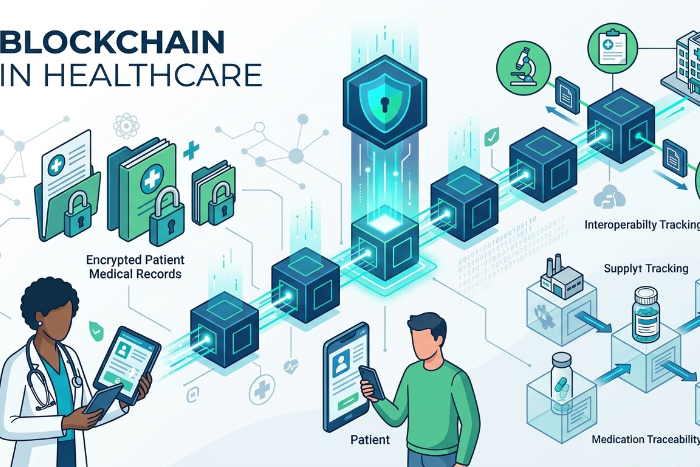
Isometric infographic illustrating blockchain in healthcare applications, featuring a central secure data chain linking encrypted patient medical records, medical provider systems, data interoperability tracking, and pharmaceutical supply chain traceability

Blockchain in Healthcare: A New Era of Security, Trust, and Transparency

Let’s face it, healthcare is overdue for a digital overhaul. From disconnected records to endless paperwork and the constant threat of data breaches, the system is ripe for innovation. Enter blockchain, a technology poised to revolutionize healthcare from the inside out.

But what exactly does blockchain bring to the healthcare table? In this blog, we’ll break it all down: what blockchain is, how it’s being used in healthcare today, what benefits it unlocks, and the challenges we need to tackle before it can go fully mainstream. Continue reading Blockchain in Healthcare: A New Era of Security, Trust, and Transparency

Spread the love
  •  
  •  
  •  
  •  
  •  
  •  
  •  
  •  
  •  
Flat vector illustration of Artificial Intelligence (AI) in Finance, showing an advanced AI robot monitoring stock trends, Bitcoin, and Ethereum data across glowing digital screens

How AI is Redefining the Future of Finance?

The finance industry is undergoing a fundamental transformation, and artificial intelligence (AI) is at its core. From banks and insurance firms to fintech startups, the entire industry is undergoing a digital evolution powered by intelligent algorithms and machine learning models.

A 2024 Gartner survey revealed that 58% of finance companies are already using AI, a sharp rise from just 37% the year before. And the money is following the momentum. The financial sector is projected to spend nearly $97 billion on AI by 2027, up 29% from 2023 levels, according to Forbes.

So what does this mean in practice? Simply put, AI is making finance smarter by cutting costs, reducing risk, and making decisions faster. Let’s explore how. Continue reading How AI is Redefining the Future of Finance?

Spread the love
  •  
  •  
  •  
  •  
  •  
  •  
  •  
  •  
  •  
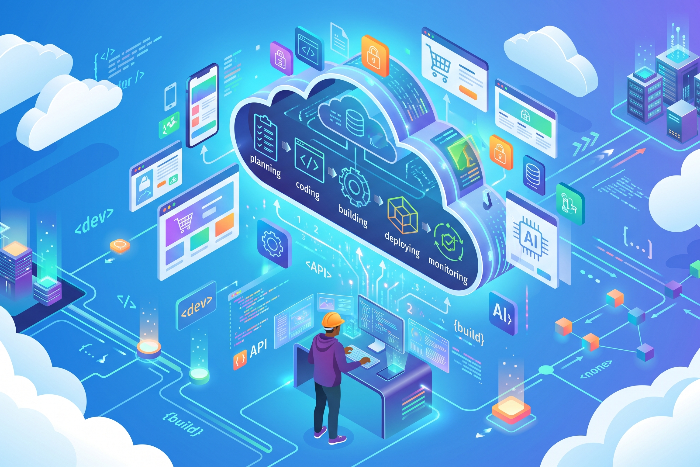
Isometric infographic illustrating a developer working on cloud application development. A central cloud highlights the lifecycle stages from planning to monitoring, surrounded by interconnected technology components like AI, databases, and user devices.

The Ultimate Guide to Cloud Application Development

Cloud computing has become the backbone of modern software. In fact, Gartner predicts global public cloud spending will hit $679 billion in 2024, and more than half of enterprises will rely on industry-specific cloud platforms by 2028. For developers and product leaders, understanding cloud application development is essential. In this guide, we explain what cloud-based applications are, how they are built, and why they matter, using industry data and real-world examples.

What are Cloud-Based Applications?

Cloud-based applications are software programs that run on remote servers rather than on a device or a company’s in-house infrastructure. While users access these apps through web browsers or mobile clients, all the heavy lifting–data storage, processing, and updates–happens in secure cloud data centers. This setup allows you to use powerful tools without managing servers or installing bulky software locally. Continue reading The Ultimate Guide to Cloud Application Development

Spread the love
  •  
  •  
  •  
  •  
  •  
  •  
  •  
  •  
  •  
Isometric illustration of a central glowing block connecting to diverse blockchain use cases, including supply chain logistics, digital identity security, smart contracts in real estate, and secure healthcare data sharing

Blockchain Use Cases Across Industries

Blockchain isn’t just about Bitcoin anymore. While it may have started as the backbone of cryptocurrencies, today it’s quietly revolutionizing how businesses operate, often behind the scenes. From ensuring the origin of mangoes at Walmart to reimagining healthcare records with patient privacy in mind, blockchain is solving real-world problems across sectors.

If you still associate blockchain only with finance, it’s time to look again. As we highlighted in our Technology Trends in 2026 overview, blockchain is evolving into a foundational technology across industries. Blockchain use cases span finance, healthcare, supply chain, and more — enabling secure transactions, smart contracts, and transparent data across industries. Continue reading Blockchain Use Cases Across Industries

Spread the love
  •  
  •  
  •  
  •  
  •  
  •  
  •  
  •  
  •  
Futuristic digital brain and glowing data streams representing advanced AI use cases.

AI Use Cases across Various Industries

A few years ago, AI was innovative, but today it’s expected already. Organizations that don’t use AI risk falling behind. From unseen optimizations to headline-grabbing innovations, AI has embedded itself deep into how industries operate, adapt, and grow.

Whether it’s helping doctors diagnose faster, enabling banks to fight fraud in real-time, or ensuring your next package arrives exactly when expected, AI is quietly transforming the way we live and work. But while the technology is powerful, its impact truly comes alive when we explore the real-world problems it’s solving across different sectors. Continue reading AI Use Cases across Various Industries

Spread the love
  •  
  •  
  •  
  •  
  •  
  •  
  •  
  •  
  •  
A clean corporate illustration of an interconnected digital ecosystem representing the Top Technology Trends in 2026, featuring AI and cloud networks

Top Technology Trends in 2026

In 2026, emerging technology trends are no longer futuristic; they start becoming the world we live in. What once felt futuristic is now seamlessly integrated into our daily lives.

AI no longer responds; it anticipates. Systems don’t just react, they adapt. From optimizing city infrastructure to streamlining business operations, technology is working silently in the background, making everything smarter, faster, and more intuitive.

The biggest trend? Its invisibility. The most powerful innovations no longer seek attention; they simply are, quietly reshaping how we live and work.

But what exactly is driving this transformation?

Let’s take a closer look at the top technology trends defining 2026. Continue reading Top Technology Trends in 2026

Spread the love
  •  
  •  
  •  
  •  
  •  
  •  
  •  
  •  
  •